Selling since 1984 
No products
Product successfully added to your shopping cart
There are 0 items in your cart. There is 1 item in your cart.
New heating industry products
-

Multifuel Heating Boiler PROSAT MULTI EKO 11 - 25 kW
PROSAT MULTI EKO is a hybrid boiler for homes and commercial buildings....
4 121,62 USD -

Boiler for kitchen stoves ERMET 80 - 140L
The horizontal domestic hot water storage tank with a back boiler...
324,05 USD

FAQ - Frequently asked questions
1. There is no description of a product?
If some parts of www.kotly.com are not translated to English yet, than please switch to Polish or German.
2. Do you deliver to ... ?
We deliver throughout Europe and America, nearly Worldwide. The cost of delivery must be paid extra, the amount depends on the weight.
3. May I pick up the boiler myself ?
Yes, no problem. We have some 200-400 boilers always on stock. But please send an email some days before so that we reserve the products for you.
4. Is it binding if I place an order ?
No, it is no problem for us. Put the biggest and most important products into the shopping cart and place an order on www.kotly.com. It enables us to prepare an offer for you in which all information will be included.
This is the best solution as we than exactly know which products you need to which address. We will then edit your order: delete products which you do not need and add articles you need in our opinion. Together with the exact transport costs we will send the edited order back to you by email.
5. What if I would like to change something in a product (bigger tank, longer pipe, additional options)?
If you want to buy a product or products but you would like to change something slightly, please don`t write just an e-mail. Better make an order (which is not binding for you) and write your suggestions in the field for notes. In this way we have a lot more information thanks to which we can give you a better and faster answer.
6. Should I pay immediately after having made an order ?
No. Do not make any transfer before you get two confirmations from us. First, you will receive an e-mail that is sent automatically. This means, that we have received your order. After that a second e-mail from our export manager with his signature and the right transport cost and account number will be sent. Then you can pay the money to our account.
7. Which Power do I need ?
Before buying a boiler, you must estimate the power. There exists a formula to calculate it. We take into consideration the cubic measure. The value of this parameter depends on the thermal insulation of the building. We assume, that buildings with a very good insulation need 40 W/m3, whilst a building without insulation needs 60 W/m3.
Example 1
We will calculate the power of a boiler for a tenement house without insulation. The building has an area of 300 m2 and the rooms height is 3m.
Boiler power = Area [m2] x Rooms height [m] x 60 W
Boiler power = 300 x 3 x 60
Boiler power = 54000 W = 54 kW
The boiler power should be about 54 kW.
Example 2
We will calculate the power of a boiler for a new house with a very good insulation. The building has an area of 150 m2 and the rooms height is 2,5m.
Boiler power = Area [m2] x Rooms height [m] x 40 W
Boiler power = 150 x 2,5 x 40
Boiler power = 15000 W = 15 kW
The boiler power should be about 15 kW.
Some countries use different measure units than the metrical. If you use BTU instead of Kilowatts and feet instead of meters, then just change them by a simple calculation.
Change feet into meters and square feet into square meters . Put them into our formula and calculate.
1m = 3.3ft and 1m2 = 10.8 ft2.
Remember, that:
1000W = 1kW = 3413 BTU,
BTU x 0.293 = W
Examples: 25kW = 85 325 BTU, 50kW = 170 650 BTU, 100kW = 341 300 BTU.
The above mentioned boiler power includes domestic hot water heating. There is no point in including in your calculations rooms that are not heated, like the garage or basement, because it leads to overestimation of the boiler power. If you do it, the boiler will not be working at the suggested temperature level 55–85 grades Celsius.
8<. what="" are="" available="" options="" b="">
When You click on a boiler description most often You will find the “available options” to choose on the bottom of the page. These options can be gratis, like left or right side of a hopper. Others are payable, like an additional grate for some boilers with a retort furnace. Also you find like this the necessary equipment for the boiler. Remember: mark the proper option before adding a product to the shopping cart.
9. Draught regulator or ventilator?
Sometimes you have to choose in the available options between a ventilator and a draught regulator. Ventilator with a steering facilitates burning of coal and its derivatives. If wood will be the basic fuel, we recommend using a draught regulator. When purchasing a boiler choose your option at the bottom of the page.
10. What is the difference between the ATMOS S and GS boilers ?
Every ATMOS S boiler has a standard ceramic plate inside the combustion chamber. The GS boilers are equipped with additional ceramic shaped inserts for even better optimization of the burning process.

11. Which tank do I need ?
You can order an accumulation tank for storing water that heats your house. This tank is constructed only for this purpose, it is made from black steel. Water from it cannot be used in Your household. There is often also a need for a domestic hot water tank (exchanger). This is to be used e.g. for washing Your hands. It is mostly enameled inside or made from stainless steel.
12. How to provide high efficiency of a boiler for a long time ?
The boiler should be regularly cleaned with a steel brush. Cleaning from flocks enables better warm gaining by the exchanger of the boiler. Appropriate brushes are available at kotly.com. The diameter of the brush must be chosen properly. It should move inside the boiler without difficulties – it cannot be too big. The best solution is a 5% smaller brush than the cleaned space.
13. Upper or lower combustion ?
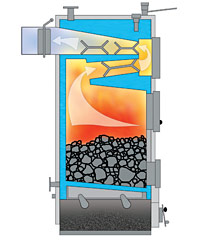
a) In case of boilers with upper combustion, exhaust gases are led directly from the combustion chamber up to the chimney. These boilers are usually high and their convectors are set horizontally. They are more popular than boilers with lower combustion because they are more universal. Generally, boilers with upper combustion can burn all solid fuels.
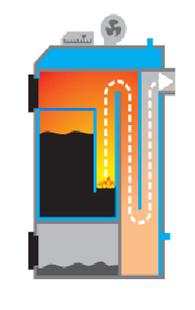
b) In case of boilers with lower combustion, exhaust gases are led from the combustion chamber first down and then up to the chimney. Convectors are long which results in high efficiency. Stronger chimney draught is for such a boiler required.
14. How can I set up a boiler with a feeder properly ?

Conveying the appropriate air to the boiler is a very important issue. The amount of air should be minimal, just for burning the fuel. Visually, it can be descripted as follows: remnants of glow should be at the edge of the retort furnace, but only ash should fall down out of it.
The coal or pellets should burn on the retort furnace, not inside. Burnt crater inside the retort furnace means too strong draught. This cools down the boiler and decreases its efficiency. Setting of the ventilator flap or its power must be adjusted to the outside temperature. The opening of the ventilator should be sometimes covered even at 80 – 90%. Lower the outside temperature, higher the natural chimney draught, hence the aeration should be limited. The combustion process must be controlled by the boiler steering, not by the chimney draught.
When the fuel is burnt properly, the flame is yellow and directs up and to the sides. White flame means too high draught. Red and smoky flame means that the draught is too weak.
The flame should be stable, it cannot blast like fire from a burner.
E.g. in the Eko–Tech boilers, the standard configuration of the feeding time to the blowing time is 1 to 3.
1st example: 10 sec. feeding with coal/30 sec. of blowing
2nd example: 15 sec. feeding with coal/45 sec. of blowing
In summer, the configuration can be at 1 to 4. E.g. 5 sec. of feeding/20 sec. of blowing.
Hysteresis should be set up at 1 centigrade (or at 2 centigrades if there is no other possibility).
Set up the time after which the feeder will work even if the set temperature has not decreased at 20 minutes.
Parameters of boiler work depend on many factors (fuel quality, installation, standard of the building, …), that is why most often the choice of the parameters should be empirical and individual.
15. How to carry a boiler with a hopper into a boiler room ?
The boiler can be disassembled into two parts. You can carry the boiler (exchanger) and the hopper separately. Then, just screw them together and seal up with high temperature resistant sealant.
16. Feeding screw blockage or constantly breaking cotter spin ?
If a feeding screw blockage or cotter break happens, first, screw off the feeding screw together with motoreducer and clean its tube inside. Something may have get into it, like coal or wood. Surely, a lot of dust must have settled inside after a long time of usage. This dust has to be removed. Unjustified, frequent feeding screw blockage or cotter breaking may be caused by corrosion or expenditure. Wet coal + acidic substances that it contains (sulfur) may have caused the problem. Uneven or porous surface, indentation, cavities result in higher resistance in the feeding screw work, which leads to its blockage, cotter breaking and switching on an alarm indicator in the steering. What to do in such a situation? The feeding screw must be polished (its surface must be smooth and shiny), painted with anti corrosive paint, or replaced. The order for a new feeding screw must include precise description of the boiler model and the manufacturer of the feeder. There must also be given the length of the working part of the feeding screw, and the length and diameter of the fitting part – axis entering the motoreducer. Another information is if the fitting part – axis has a molded groove for chock and if there is a hole for a cotter spin.
17. Deflector in my boiler is effete and has fallen down from its reprieve after a halve year of usage - why ?
Deflector is an exploitation element of a boiler just like a grate in a traditional boiler. In the same way, it must be sometimes replaced with a new one. The lifetime of a deflector may be shorter because of too high and intense aeration from a ventilator. If a deflector is damaged after a short time of exploitation, it is not a fault of a boiler, but an inevitable consequence of an exaggerated aeration. Aggressive glow from the retort furnace caused the damage. It is a situation in which the boiler works not as a heating appliance but as a smith’s fireplace in which metals are melted – this leads to the damage of a deflector.
18. What if I do not use my boiler ?
A boiler that is not used at the moment, must be still filled with water. One should not discharge the installation during summer. Instead, in the summer all the doors of the boiler should be open in order to provide draught that will dry the boiler from humidity. Also the steering of your boiler should be switched off so that a lightening cannot do any harm. Even during heating season it should be disconnected when there is tempest outside, as it may cause damage to the steering.
19. Why does my chimney or a combustion chamber emit smoke ?
If aeration is higher than the chimney draught, the boiler will emit smoke. You need to investigate what is the purpose:
- inappropriate chimney (holes, pierces into other chimney ducts)
- too small height or section
- lack of insulation outside the chimney
- additional appliances connected to the same chimney duct
- polluted duct or boiler
- bad construction of an elbow or elbows (acute angles, too many elbows)
- lack of ascension of the flue duct (exhaust gases should flow slightly up after having left the boiler)
- flue duct too deeply in the chimney
- too big ventilation opening in the wall (it may generate opposite air direction)
Additionally, in boilers with an automatic aeration, air flow should be limited:
- by using a metal flap of a ventilator
- by setting up parameters in the steering of a boiler